By tariqriaz
A Personal Manifesto on Men’s Health, Peace, and Humanity
Introduction:
We readily champion women’s health, rights, and roles – and rightly so. But what about men´s? What happens to their emotions, bodies, lives, and lifespans when culture forbids them from being vulnerable?
As a woman and as a mother, daughter, sister, partner, and friend, I witness firsthand how the male role can sometimes poison the very man it was meant to shape.
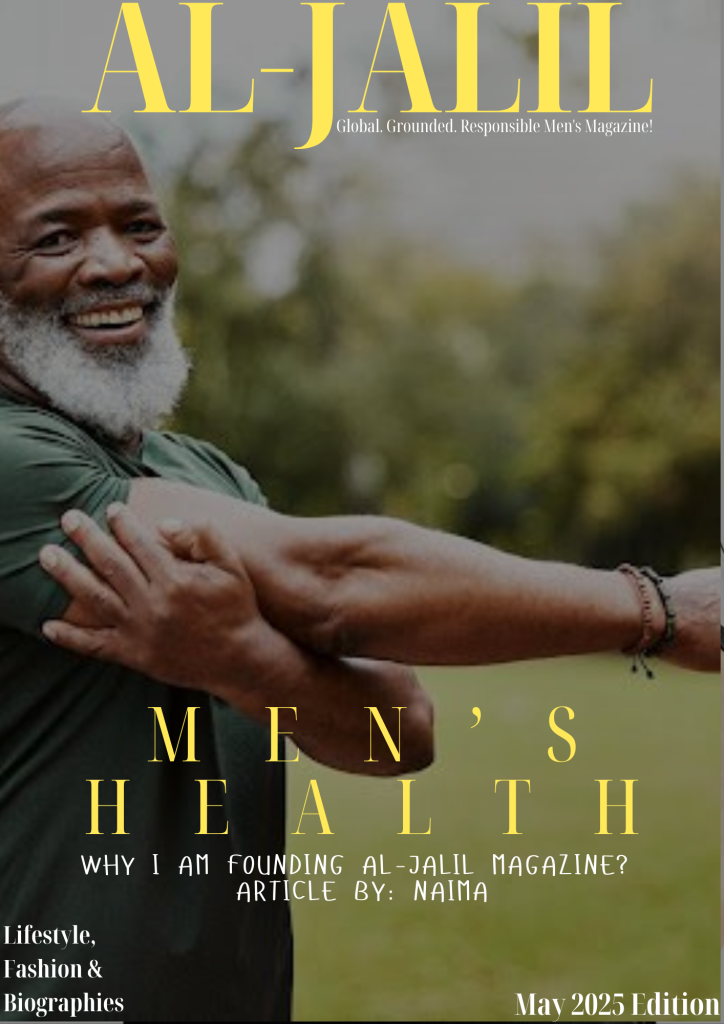
This is not just an article; it is an explanation of why I choose to start Al-Jalil. A magazine that aims to promote wholeness, health, and hope for men and, ultimately, for all of humanity.
In a world grappling with conflict, repression, and profound societal confusion, the health and wholeness of men are not just personal matters, but critical foundations for peace and progress.
This is not just an article; it is an explanation of why I choose to start Al-Jalil. A magazine that aims to promote wholeness, health, and hope for men and, ultimately, for all of humanity.
I keep repeating!
Men’s Health Concerns Us All
Men’s health is not an isolated issue. It does not concern only the individual, it concerns us all. I write this as a woman, but also as someone who loves and lives close to men: as a mother, sister, daughter, partner, and friend. Women are constantly present in men’s lives. From the first breath, when a mother holds her son in her arms, to every significant relationship he ever has. We are there, often in the background, sometimes in the shadows, but always present.
When men suffer in silence, it is not only they who suffer. Their entire surroundings are affected. And we women sense it, we see the traces in relationships, in children’s eyes, in the silences around the dinner table. It is not about women taking responsibility for men, but we cannot ignore that we live amidst the consequences of their ill health.
A Global Crisis in Silence
The statistics are grim: globally, men live on average four to seven years shorter than women. In some countries, the difference is even greater. Men are significantly overrepresented when it comes to suicide, drug abuse, violence-related deaths, workplace accidents, and chronic diseases such as cardiovascular problems.
But behind the numbers often lies silence. Men seek medical care less often than women. They do not speak as openly about mental health issues, and many still feel alienated from their own vulnerability. It is not the body that is the problem, it is the culture. And culture is something we create together.
When Masculinity Becomes Toxic
The traditional male role has for generations rewarded strength, performance, and control, but punished sensitivity, openness, and introspection. This creates a toxic silence, where emotions have no language and pain lacks outlets. And what happens to feelings that cannot be expressed? They find their way out as anger. As a need for control. As violence. It is no coincidence that the majority of the world’s perpetrators of violence are men. That it is men who are more likely to commit assaults, start wars, kill and die. Not because they are born dangerous, but because they are often raised into a role where empathy is seen as weakness, and where conflict resolution occurs with power instead of words.
War, in that sense, is a tragic expression of a male role in crisis. Behind every aggressive leader, every act of war, every hardened soldier, there is often a boy who was never allowed to cry. When men lose touch with their own vulnerability, we all lose touch with our humanity.
Culture and Mindset Shapes Biology
It is easy to believe that the differences in health between men and women are “natural.” But much of what we call biology is actually the result of culture: lifestyle, work environments, diet, social norms, emotional access. A man’s testosterone level is affected by stress. His heart is affected by loneliness. His immune system is affected by sleep, diet, self-esteem, and so on.
When culture says that men should not ask for help, not talk about their feelings, and not show weakness, it shapes the body. It literally creates disease. We therefore need to talk about the male role as something malleable, not as a biological destiny.
We Women Are Not Spectators – We Are Co-Creators
Behind and beside every man is at least one woman. A mother. A sister. A partner. A daughter. A friend. We are there when men are shaped, when they struggle, when they fall and when they rise. We are not just witnesses, we are active parts of their lives.
We can contribute to change. By affirming men in their feelings. By creating space for conversation, without shame. By standing up against destructive ideals, and showing that care, self-awareness, and presence are as much parts of masculinity as strength and responsibility.
We should not save men but we can love them into wholeness.
From Silence to Security
Men’s health is a peace project. A societal interest. A human responsibility. And for me, a deeply personal commitment.
It is time to break the silence. Time to talk about how the male role has been shaped and how it can be changed. Time to acknowledge that men’s health is never a private matter. Because every time a man is allowed to be whole, present, open the world also becomes a little more whole.
And it often begins where men first encounter life: in a woman’s arms.
The Vision Behind Al-Jalil
Al-Jalil means “the noble” – a name chosen with intention.
This platform was born from the conviction that true strength lies in wholeness. That men deserve more than silence, stereotypes, and suppressed pain. That masculinity, at its most noble, is not about dominance but about presence, responsibility, tenderness, and truth.
Al-Jalil exists to explore, heal, and reimagine the male experience through stories, reflections, science, art, and honest dialogue. We aim to build bridges between genders, generations, and geographies. We believe men’s health is not a niche issue, it is a global one. It affects relationships, communities, economies, and the future of peace.
We invite all who care about men, men themselves, and the women beside and behind them to join this conversation. Not to “fix” men. But to restore the freedom for men to be fully human.
In a world torn by conflict, repression, and confusion, we believe that noble masculinity is our only way forward!
Al-Jalil – is not a luxury.
It is a necessity!
Naima